 In My
In My Today Is My Birthday, and I Am Celebrating by Declaring War on Toxic Workplace Culture
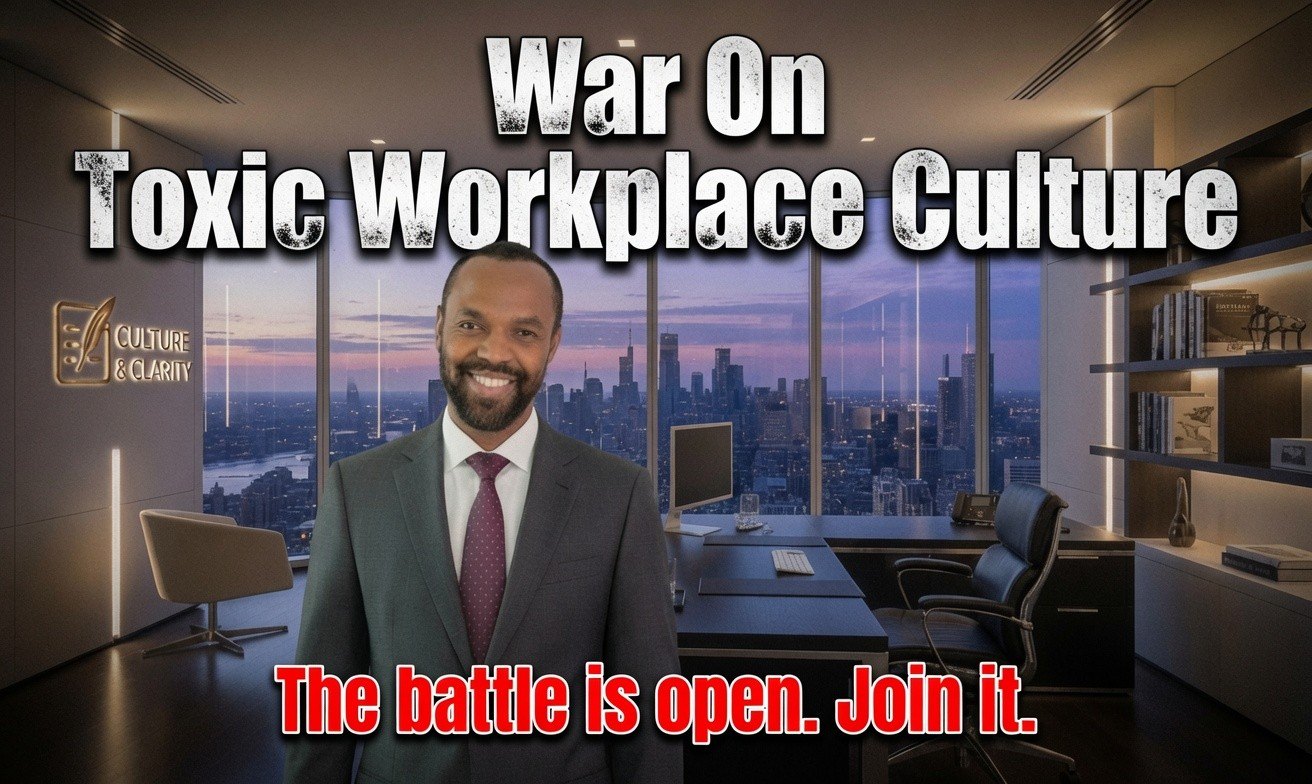
Nearly seven in ten workers say they have experienced a toxic workplace — and most of the tools meant to help only ever speak to one half of the problem. So on my birthday, I'm launching two: one for the person living inside a toxic culture, and one for the organisation that keeps producing it.
Tonight in San Francisco, New York, Seattle, London and Washington, a manager will send an email that uses the word "opportunity" when what they mean is "you're on thin ice."
Somewhere a high performer will be left off a meeting invite for the third time this month and wonder, again, if they're imagining it. Somewhere someone who has already decided to leave will stare at a blank resignation draft, calculating how much dignity they can still salvage from the exit.
These are not dramatic stories. They are ordinary ones. In 2026 they remain stubbornly common. Nearly seven in ten workers say they have experienced a toxic workplace. Leadership is blamed by the overwhelming majority. People are still quitting without another job lined up because the alternative feels worse. Mental health metrics keep sliding. AI is being layered on top of the same old power dynamics, sometimes making the distance between managers and the people they manage even wider.
I decided the only rational response was to fight.
The 2 a.m. Problem No One Was Solving
I did not set out to build another engagement dashboard or another wellness chatbot that offers breathing exercises while the structural problem continues. I watched the gap between what employees live and what organizations measure and decided both sides needed different weapons.
The result is two products that refuse to speak only to one half of the problem.
In My Corner is the fire extinguisher. Five specialized AI companions that appear when someone is already in the middle of it. One steadies the person who is asking whether the gaslighting is real or whether they are simply "too sensitive." One takes a photo of the carefully worded HR letter and translates the corporate language into plain English (French or Spanish), flags the missing pieces, and surfaces the actual deadlines that apply in their jurisdiction. One helps capture incidents while they are still fresh and turns the mess into a dated, exportable case file. One supports the practical work of leaving without destroying the reference or the remaining confidence. One helps the user understand how cultures become toxic so the experience is no longer pure chaos.
Nothing is stored on our servers. The crisis layer that detects real distress is never paywalled. The product is explicit about its limits: it is not a lawyer, not a therapist, and it will tell you when to stop and speak to a human.
Culture Blueprint is the other end of the same fight. A ten-minute anonymous audit that measures psychological safety across four domains that research actually links to performance: emotional safety, coherence between stated values and daily behavior, trust, and how the team is handling AI. Then two AI coaches step in — Ted for leadership development and Sarah for organisational psychology. Both already know your results. Both will answer any question you throw at them and suggest a concrete way forward, including clear 30/60/90-day plans. No more pretty scores that die in a slide deck.
One product stands with the person when the culture fails them. The other gives organizations a way to stop manufacturing those failures.
Building the Slingshot With No Code and Almost No Sleep
I built both products using AI. No traditional code. Sleepless nights. The usual bootstrapped catalogue of problems: money that disappears faster than expected, features that refuse to behave, the particular loneliness of working on something that feels urgent while the rest of the world treats it as optional.
What kept me going was the steady stream of messages from LinkedIn. People from different countries, different industries, different levels of seniority writing variations of the same sentence: I needed this years ago. That global encouragement became its own kind of fuel.
Right now both products live as web apps. Android is coming next. iOS after that. The stance is deliberately pro-human. The technology is not meant to replace the hard conversations, the lawyers, the therapists, or the leaders who actually do the work. It is meant to reduce the number of people who have to face the machinery of a toxic workplace completely alone, and to give the people with power a clearer, less flattering mirror.
This Is Your Call
From the San Francisco Bay Area to Greater Bengaluru, from New York and Seattle to London and Washington, from Boston, Austin, Dallas, Los Angeles and Singapore — this is your call.
Never in the history of modern work has so much quiet damage been done by so few, to so many.
We do not have the corporate means. We do not have the legal budgets or the institutional protection. What we have is something more durable: the lived experience of millions who have sat alone with the letter, the exclusion, the eroded confidence, and the decision to leave without a soft landing. What we have is the will to stop treating this as inevitable.
We are David with a slingshot.
The long-term intention is unambiguous: become the force that toxic cultures have to reckon with.
Most tools in this space still speak to only one side of the table. Wellbeing apps offer individual coping. Culture platforms offer organizational data. The person lying awake and the leader looking at the dashboard remain in separate rooms, using separate languages, sold to by separate companies.
Culture is inherently two-sided. It is lived by individuals and shaped by systems. You cannot repair it from only one end.
Support the person in the immediate crisis. Give the organization a practical way to change the conditions that keep producing crises. Do both without the usual marketing fog about AI saving the world.
The products are still early. Web only for now. I am still the kind of person who will stay up rewriting prompts at 3 a.m. because a user somewhere might open the app at 3:07. The LinkedIn messages keep arriving. The war has been declared in public.
Whether the slingshot is enough remains an open question. That is, in a way, the point of putting it out on my birthday instead of waiting for perfection. The people who have lived the quiet dismantling of confidence, the carefully worded letters, the decision to leave without a soft landing, will be the ones who decide if the tools are sharp enough.
Somewhere tonight someone is still rereading an email and wondering if the problem is them. They now have somewhere else to take the question.
And the organizations that prefer the problem to stay invisible have been put on notice.
The battle is open. Join it.
Five AI companions who steady you, decode the HR letter, and keep your case file. Private by design.
Try In My Corner — freeA 10-minute anonymous read on your culture, with two AI coaches and a 30/60/90-day plan.
Run the Culture Blueprint audit